Step into almost any modern kitchen, and you’re likely to encounter a host of powerful appliances designed to simplify cooking. Among the most common are the blender and the food processor, two versatile machines often mistakenly thought to be interchangeable. While both boast spinning blades and help transform ingredients, believing a food processor is the same as a blender is a common misconception that can lead to culinary frustration. Understanding their distinct functionalities, strengths, and ideal uses is key to mastering your kitchen and achieving perfect results every time. This guide will clarify the unique roles of these two kitchen workhorses, helping you decide which one, or perhaps both, belongs on your countertop.
Understanding the Food Processor
At its core, a food processor is a multi-talented kitchen assistant primarily designed for preparing solid and semi-solid ingredients. Think of it as your personal sous chef, ready to tackle a wide array of chopping, slicing, shredding, and mixing tasks with impressive speed and precision. Its robust motor and unique design allow it to handle demanding jobs that would be tedious or impossible by hand.
The hallmark of a food processor is its wide work bowl and versatile S-shaped blade, which sits low in the bowl and spans most of its diameter. Unlike a blender, food processors come with an assortment of interchangeable discs and blades. These attachments can slice vegetables uniformly, grate cheese effortlessly, shred cabbage for coleslaw, or even knead dough for bread and pastries. A feed tube on the lid allows you to add ingredients safely while the machine is running, providing continuous processing for larger quantities.
Common Uses for a Food Processor:
- Chopping & Mincing: Quickly chop onions, garlic, herbs, nuts, or make breadcrumbs.
- Slicing & Shredding: Create uniform slices of fruits and vegetables for salads, gratins, or chips; shred cheese, carrots, or cabbage.
- Pureeing & Blending (Thicker Consistencies): Ideal for making hummus, pestos, nut butters, thick dips, or chunky salsas.
- Dough Kneading: Some models come with a dough blade to effortlessly mix and knead dough for various baked goods.
- Grinding Meat: Grind raw meat for homemade burgers or sausages.
Unpacking the Blender
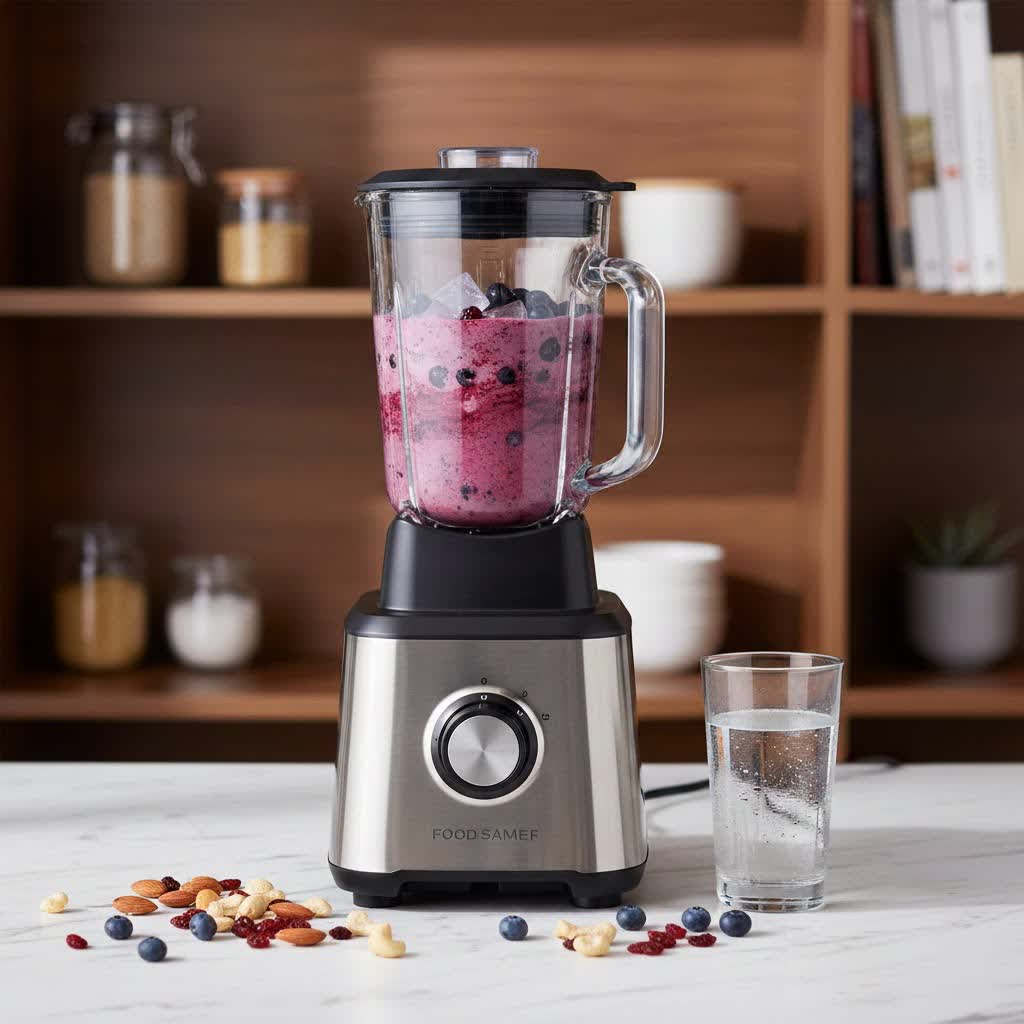
The blender, on the other hand, is a specialist in creating smooth, uniform liquid mixtures. It excels where the food processor often falls short: achieving a silky-smooth consistency for beverages and sauces. If your culinary goals lean towards drinks, creamy textures, and liquid-based preparations, the blender is your go-to appliance.
Blenders are characterized by their tall, narrow jars, which are typically made of glass, plastic, or Tritan. The design of this jar, combined with the rapidly spinning, often fixed, multi-pronged blade at its base, is crucial. This configuration creates a powerful vortex that pulls ingredients downwards into the blades, ensuring thorough and consistent blending. Most blenders also feature high-speed motors specifically engineered to pulverize tough ingredients, including ice and frozen fruits, into a smooth liquid. Unlike food processors, blenders usually require a certain amount of liquid to operate effectively, as the liquid helps circulate the ingredients through the blades.
Common Uses for a Blender:
- Smoothies & Shakes: Effortlessly blend frozen fruits, ice, and liquids into perfectly smooth beverages.
- Soups & Sauces: Puree cooked vegetables into creamy soups or create smooth sauces, gravies, and salad dressings.
- Crushing Ice: Efficiently crush ice for cocktails or slushies.
- Emulsifying: Ideal for making mayonnaise or vinaigrettes where a stable emulsion is desired.
- Baby Food: Blend steamed fruits and vegetables into smooth purees for infants.
Core Differences: Food Processor vs. Blender
While both appliances contribute significantly to meal preparation, their fundamental differences make them suitable for distinct tasks. Understanding these distinctions is crucial to utilizing each tool effectively and avoiding disappointment in the kitchen.
Blade Design and Functionality
|
Our Picks for the Best Food Blender in 2026
As an Amazon Associate I earn from qualifying purchases.
|
||
| Num | Product | Action |
|---|---|---|
| 1 | BLACK+DECKER PowerCrush Multi-Function Blender with 6-Cup Glass Jar, 4 Speed Settings, Silver |

|
| 2 | Ninja Professional Blender 1000W, Total Crushing Technology- Smoothies, Ice Crushing & Frozen Fruit, Full-Size Countertop Blender, 72-oz. Pitcher, Black & Grey, BL610 |
|
| 3 | Countertop Blender, 2000W High-Power Smoothie Blender with 68oz BPA-Free Jar, 28,000 RPM, Variable Speed & Pulse, 8-Blade Stainless Steel, Tamper Included, Quick Self-Cleaning, Dishwasher-Safe Jar |
|
| 4 | Ninja Mega Kitchen System, 1500W, 72 oz. Full-Size Blender & 8-Cup Food Processor with (2) 16 oz. Cups , Black, BL770 |
|
| 5 | Ninja Fit Compact Personal Blender, Portable Blender for-Smoothies, Shakes, Food Prep, and Frozen Blending, 700-Watt Base, (2) 16-oz. Cups and Spout Lids, Black QB3001SS |
|
| 6 | BLACK+DECKER Countertop Blender with 6-Cup Glass Jar, 10-Speed Settings, Black, BL2010BG |
|
| 7 | Hamilton Beach Power Elite Wave Action Blender For Smoothies, 40 Oz Glass Jar, 12 Functions Including Puree, Crush Ice, 700 Watts - Black (58148A) |
|
| 8 | Vitamix Ascent X5 Blender with 10 Blending Programs, Self-Cleaning Program, Professional-Grade Blender for Smoothies, Soups and More, Stainless-Steel Blades, 48 Oz Container, Brushed Stainless |
|
| 9 | Turelar Immersion Blender Handheld Corded Hand Blenders Set 1100W, Trigger Variable Speed 5 in 1 Stick Emulsifier with Chopper, Whisk and Frother for Soup, Baby Food and Smoothies |
|
| 10 | Vitamix Explorian E310 Blender, Professional-Grade Kitchen Blender for Smoothies, Soups, Juices and More, 10-Speed, Stainless Steel Blades, Self-Cleaning Kitchen Appliance, 48 Oz Container, Black |
|
The most apparent difference lies in their blades. A food processor typically uses an S-shaped blade for chopping, mixing, and pureeing, along with a variety of discs for slicing, shredding, and grating. These blades operate at slower speeds but with greater force, designed to cut and process solid ingredients. Blenders, conversely, feature a single, fixed blade assembly with multiple prongs, designed to create a powerful vortex. This vortex is essential for drawing liquid ingredients down into the rapidly spinning blades, ensuring an ultra-smooth consistency.
Container Shape and Capacity
Blenders almost always come with a tall, narrow jar. This design is integral to creating the vortex action that efficiently blends liquids. Food processors, however, have a wide, shallow work bowl. This broader base accommodates larger quantities of solid ingredients and provides ample space for slicing and shredding discs to operate effectively, making them ideal for bulk food preparation.
Required Ingredients and Consistency
A blender thrives on liquids. Whether it’s water, juice, milk, or broth, a certain amount of liquid is generally needed for the blades to create the necessary vortex and achieve a smooth consistency. Attempting to blend dry or very thick ingredients in a blender can strain the motor and yield uneven results. Food processors, conversely, are built for drier, thicker, and harder ingredients. They excel at chopping nuts, grinding grains, and mixing dough without the need for additional liquid, producing chunky, shredded, or finely chopped textures.
Speed and Power
Blenders often boast high-speed motors designed for pulverizing and liquefying ingredients quickly. Their focus is on achieving a smooth, uniform output. Food processors, while powerful, typically operate at lower speeds but offer more control over the texture, often featuring pulse settings to prevent over-processing and allow for precise chopping or mixing. This controlled power is vital for tasks like making chunky salsa or finely chopping herbs without turning them into a paste.
Versatility and Attachments
A food processor’s main advantage in versatility comes from its array of interchangeable attachments. With various slicing, shredding, grating, and kneading discs, it can perform numerous prep tasks beyond simple chopping. A blender’s versatility is more focused on its ability to create different liquid consistencies, from thin juices to thick shakes, but it rarely offers the same breadth of attachments for processing solid foods in diverse ways.
Overlapping Functions: When Can They Be Interchangeable?
While distinct, there are certain tasks where both a food processor and a blender might technically get the job done, though one will almost always perform better. Both can puree cooked vegetables for soups or sauces, for example. A blender will yield a silky-smooth texture, perfect for a creamy bisque, while a food processor might produce a slightly chunkier, more rustic consistency, which could be desirable for certain hearty vegetable soups.
Similarly, thick dips like hummus can be made in either. A food processor will typically achieve the desired thick, somewhat grainy texture more easily, requiring less scraping down of the bowl. A powerful blender can also make hummus, but it might require more liquid or tamping to get the ingredients moving and could result in a smoother, less textured dip. Emulsified dressings are another area of overlap; a blender excels at creating perfectly stable emulsions, while a food processor can also manage, though perhaps with a bit more effort.
The key is to consider the desired final texture. If you want something incredibly smooth and liquid, reach for the blender. If you need precise chopping, slicing, grating, or a thicker, more textured puree, the food processor is the superior choice.
Choosing the Right Appliance for Your Needs
Deciding whether to invest in a food processor, a blender, or both, depends heavily on your individual cooking habits and kitchen space.
Assess Your Cooking Habits
- Frequent Smoothies & Shakes? If daily smoothies, protein shakes, or blended soups are part of your routine, a high-quality blender is indispensable.
- Extensive Meal Prep? If you often chop vegetables for stir-fries, shred cheese, make homemade pesto, or knead dough, a food processor will be a game-changer for saving time and effort.
- Both? For avid home cooks who enjoy a wide range of culinary endeavors, owning both appliances provides the ultimate versatility.
Consider Your Kitchen Space
Kitchen space is a precious commodity. If you have limited counter or cabinet space, a combination appliance that offers both blending and food processing functions (often with interchangeable bases or attachments) might be a practical solution. However, dedicated blenders and food processors often offer superior performance in their respective primary functions compared to combo units.
Budget and Brand Reputation
Both blenders and food processors come in a wide range of prices and with varying features. Researching reputable brands known for durability and performance can help ensure your investment lasts. Consider the wattage for blenders (higher for crushing ice) and the bowl capacity and attachment variety for food processors to match your needs.
Tips for Using and Maintaining Your Appliances
To ensure your food processor and blender serve you well for years to come, proper usage and maintenance are essential.
- Read the Manual: Always consult your appliance’s manual for specific instructions on assembly, operation, and cleaning.
- Don’t Overfill: Respect the maximum fill lines to prevent spills and motor strain.
- Cut Ingredients Appropriately: For food processors, cut ingredients into uniform pieces that fit the feed tube. For blenders, smaller pieces help ensure smoother blending.
- Pulse, Don’t Continuously Blend (for Processors): Use the pulse function on a food processor for chopping to achieve desired textures and avoid over-processing.
- Clean Immediately: Rinse the jars, bowls, and blades immediately after use to prevent food from drying and sticking, making cleanup much easier. Most parts are dishwasher safe, but check the manual.
- Safety First: Always ensure the lids are securely fastened before operating, and keep hands and utensils away from moving blades.
Conclusion
The journey through the world of kitchen appliances reveals that a food processor is unequivocally not the same as a blender. While they share the fundamental action of using spinning blades to transform ingredients, their designs are specialized for distinct purposes: the blender for achieving ultra-smooth liquid consistency and the food processor for versatile, precise handling of solid foods. Both are invaluable tools, each capable of simplifying different aspects of meal preparation. By understanding their unique strengths, you can confidently choose the right appliance for your culinary adventures, saving time, reducing effort, and elevating the quality of your homemade dishes. Which appliance will you reach for first in your next kitchen creation?
